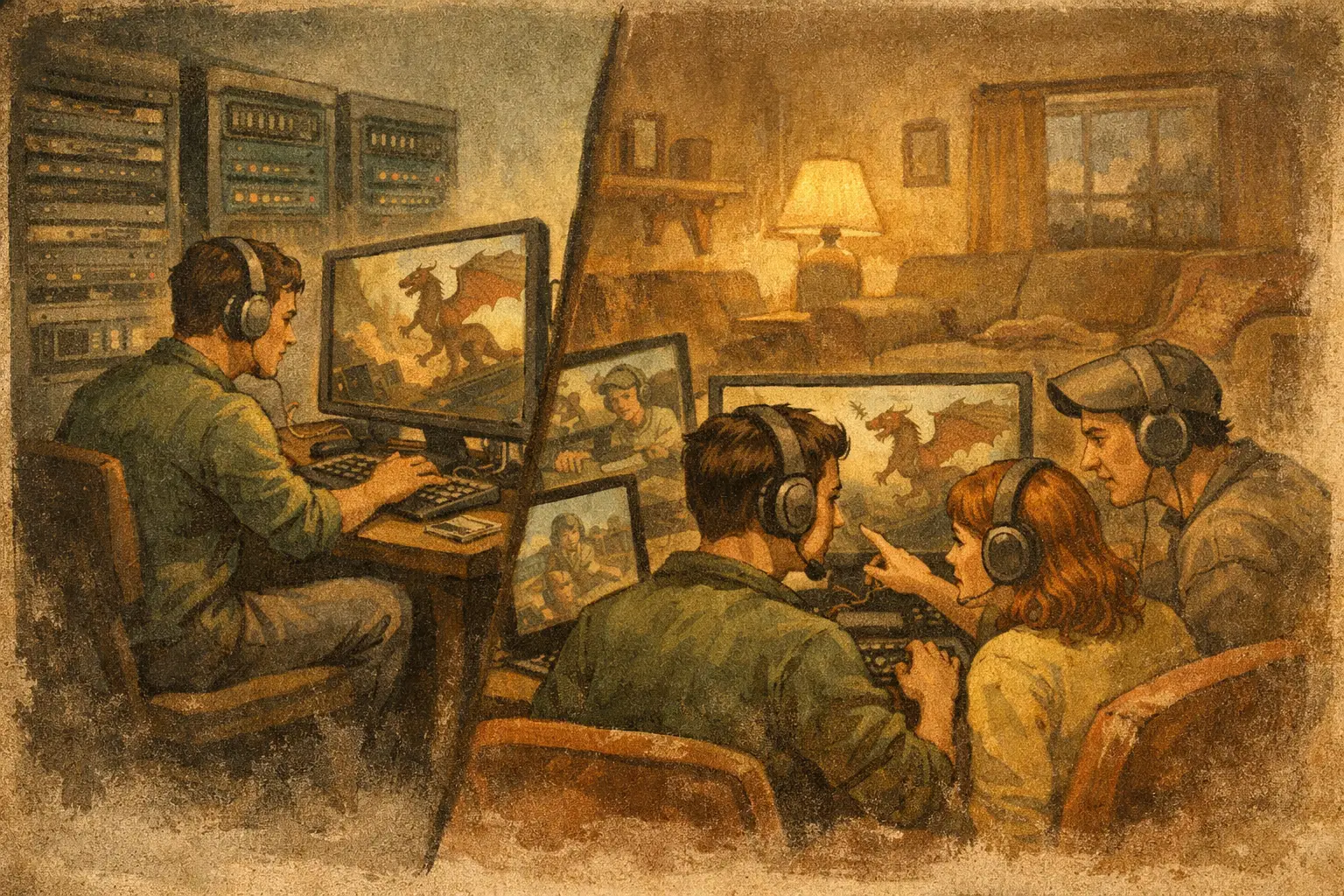
Your group chat starts with, "Fancy a quick session tonight?" and ends with someone asking who still has the world file, who overwrote it, and why you’re all apparently paying monthly just to play twice a week. If you’re looking for a dedicated server alternative for friends, the real question usually is not, "How do we host this like a data centre?" It’s, "How do we keep the save safe, make handoffs painless, and stop one mate’s PC from becoming the single point of failure?"
For plenty of co-op groups, a dedicated server is overkill. Not bad. Just overkill. It solves uptime, but it also brings rental costs, setup time, admin chores, mod headaches, and that special flavour of annoyance where the server bill keeps ticking while nobody has touched the game in nine days.
When a dedicated server is the wrong tool
Dedicated servers make sense when your world needs to be online all the time, when lots of players join at different hours, or when the game is effectively a shared public space. Minecraft communities, heavily trafficked Valheim worlds, or factory games with a dozen chaotic gremlins all hopping in whenever they like can justify it.
But most friend groups are not running a miniature MMO. They play in planned sessions. They want the same world next Friday. They need the mods to load properly. They do not want to spend part of every evening doing unpaid IT support because someone updated a mod loader and detonated the save.
That is where a dedicated server alternative for friends starts to make more sense. If your actual problem is world ownership, backups, version history, and host handoff, then renting a machine is often solving the wrong problem elegantly and expensively.
What friends usually need instead
Most casual co-op groups need four things.
First, they need the world file to stop living in one person’s mysterious save folder like a hostage. Second, they need protection from bad sessions, corrupted mods, and accidental overwrites. Third, they need a clean way to pass the save between people without spawning five conflicting versions called "FINAL", "FINAL2" and "FINAL-real". Fourth, they need this to work without everyone earning a side career in server administration.
That points to a simpler model. One person hosts the live session when the group is actually playing. The save is backed up automatically. Every change is versioned. When the host changes, the world passes cleanly to the next person. If something goes sideways, you roll back in seconds instead of holding a digital funeral.
The best dedicated server alternative for friends is often save-based co-op
For games built around local or peer-hosted worlds, save-based co-op is usually the practical answer. Instead of paying for permanent uptime, you manage the thing that actually matters: the world state.
This works especially well for games like Stardew Valley, Valheim, Satisfactory, Factorio, Terraria, and plenty of modded titles where the world save is the heart of the session. Your group only needs access when you’re playing. Outside that window, nobody benefits from a server humming away in a rack somewhere while your crops wait patiently in silence.
The trick is doing save-based co-op without the usual mess. Manual copying works right up until somebody forgets. Shared folders sound clever right up until sync conflicts happen. Sending save files in Discord is a fast route to chaos, especially if two people think they’re holding the latest version.
A proper setup adds rules to the process. One active owner at a time. Automatic backups. Clear restore points. Shared access without unrestricted file carnage. That is a much better fit for most friend groups than full server infrastructure.
What you gain and what you give up
Let’s be fair to dedicated servers. They do offer a big advantage: the world can exist independently of any one player. If your mates keep bizarre hours or like to drop in solo, that matters.
But here’s the trade-off. You pay for that convenience with money, setup friction, maintenance, and extra weirdness around mods, plugins, updates, and permissions. Depending on the game, you can also end up dealing with server-side quirks that simply do not exist when one of you hosts locally.
A save-sharing approach flips the priorities. You give up 24/7 world availability, but you gain lower cost, less admin, easier mod parity, and much better control over save history. For a tight friend group that plays together at agreed times, that is usually a very good swap.
It also handles the emotional bit better. A dedicated server can still suffer bad updates, broken mods, or a mate accidentally bulldozing half the base. The difference is that with version history and quick restore, a disaster becomes a minor annoyance rather than a week-ending catastrophe.
How to tell which setup fits your group
If your world needs to be live all day, every day, go dedicated. No need to pretend otherwise.
If your sessions are scheduled, your player count is small, and your biggest recurring pain is save chaos rather than uptime, then a dedicated server alternative for friends is probably the smarter move. That is doubly true if you mostly play save-heavy games where continuity matters more than constant access.
Ask a few brutally simple questions. Do people actually need to log in when the host is offline? Are you paying monthly for a server that sits empty most of the week? Is the real problem hosting, or is it backups and handoff? Has your group already had at least one incident involving a corrupted save, a missing world file, or someone confidently loading the wrong version? If the answer to the last one is yes, welcome to the club.
A better setup looks boring, and that’s the point
The best co-op tooling is not flashy. It quietly prevents nonsense.
A good save-based workflow watches the relevant save folder automatically, uploads changes as they happen, stores previous versions, and lets the group hand control from one person to another without duplicate edits. If a host’s drive throws a tantrum or a mod pack implodes, the save can be restored to a known good state. If a creator wants friends to use a world without trashing the original, read-only sharing keeps things civil.
That sort of setup is especially useful for modded games, where instability is less an occasional surprise and more a recurring character. One dodgy load order can ruin an evening. Having a rollback point turns that from "we’ve lost the world" into "give me thirty seconds".
This is where a tool like Checkpoint64 fits naturally for the right crowd. Not as a fake server. As a cleaner answer to the actual problem. It handles automatic backups, version history, restore points, and controlled co-op save sharing, which is exactly what many friend groups need when a dedicated server feels like hiring a bouncer for a book club.
Common cases where this works brilliantly
For Stardew Valley co-op, the host can pass the farm safely without manually zipping folders and hoping for the best. For Valheim or Terraria groups who only play together on weekends, the world can move between hosts with proper version control instead of folklore and luck. For Factorio and Satisfactory players, where one mistaken save can wipe hours of work, rollback matters almost as much as hosting.
It is also excellent for households and friend groups split across devices. If someone switches PCs or reinstalls the game, the save does not vanish into the void with their old drive. The world survives, which is more than can be said for many friendships after a lost 80-hour run.
The part nobody mentions about cost
Server rental looks cheap until it quietly isn’t. A few pounds here, a few months there, and suddenly you have paid quite a lot for the privilege of not solving your actual save-management problem.
If your group plays casually, buying into proper save protection once can make far more sense than renting forever. Especially if your sessions are irregular. Especially if your game already works fine with one person hosting. Especially if the thing you are really afraid of is not downtime, but losing progress.
That is the crux of it. Friends do not usually need enterprise hosting. They need a world that survives real life, bad mods, PC upgrades, and that one mate who clicks first and reads later.
If that sounds familiar, stop asking how to imitate a dedicated server and start asking how to protect the save, share it safely, and keep the game night running. That is the setup you’ll actually thank yourself for when the chaos starts.